
Musings
Seeing into the past
As social media likes to dredge up the memories we committed to the internet, it reminded me today of a very nice and not so distant one. Two years ago, I finished and gave my dad a portrait of his birth mother, Edith. Neither of us had the chance to meet her – she passed two days after he was born. Regardless, I know she was a large influence for him.
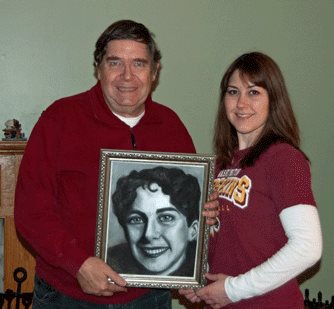
Looking at this photo today made a few gears start turning and compelled me to write.
In a recent post, I described the act of creating as the practice of seeing, observing and translating. I left out one detail I think many creative types can agree they experience often: you never stop observing more, and as a result you see the things you could have done differently in your previous work.
It’s not to say that I’m unhappy with the portrait of my grandmother, but there are things I see now that I didn’t before. Taking a step back and looking at it with fresh eyes, I realize I flattened out the planes of space on the left side of her face, and perhaps outlined her teeth less subtly than I should have among a few other things. I won’t go back and do a thing to the drawing because I know it brings my dad joy as it is.
Maybe the aforementioned detail can be said of all things in life. When you leave them behind and revisit them days, weeks, months, or years later, your perspective is inherently different because of all that you have seen and observed in the meantime. Wisdom.
My dad loves to take photographs. He’s done it ever since he was much younger than I am now. Photographs of things we may take for granted…leaves blanketing a forest floor, the snow falling around a lit lamp post, the patterns in tree bark, the winding fence posts that trail off into the horizon, the way light and shadows fall upon a person’s face. My dad loves to see and observe. That’s part of why he’s so wise – and I’m not just saying that because I’m biased (well, maybe I am, but I write in earnest when I say he’s one of the wisest human beings I know and I happen to keep the company of many very smart people). Just as my dad’s “mum” was influential for him, so too is he for me. He taught me how to see and observe.
It’s so easy to stop at seeing. We move from one stimulant to another in milliseconds. But, if you take a minute to observe what you’re seeing, you may comprehend what you couldn’t before – in your art and in your life.
You Can Do It: The Eternal Optimist Strikes Again
Often times I’ve heard it said, “I wish I could [draw/paint/create], but my best is pretty much stick figures.”
And usually without hesitation, my response is “You can do it,” which is then met with insistence that there’s no way that could be.
Does it help to have skill or talent? Of course. But I maintain that while there are tricks of the trade, creation is really the practice of seeing, observing and then translating. I say “the practice” because with all things in life, the more we do something the better we’re able to do it.
The more we look at things and see them, the more familiar they become. In the process, we observe more about what we’re seeing. And then we engage in the fun (and sometimes infuriating) part of creating which is to explore a medium and experiment with it to recreate or translate what we’re seeing into something entirely it’s own. Each time, there is something new to be noticed that we hadn’t seen before and a sharpening of our skill set.
There’s no one right way to do it, but if you want to draw here’s a start: Pick up a pencil and start recording what you see in whatever fashion you can. Then do it again. And again. Or, I’ll teach you. Shoot me an email and we can do it together.
(The way light hits basic shapes is good to observe and record. But your own face is always readily available too.)
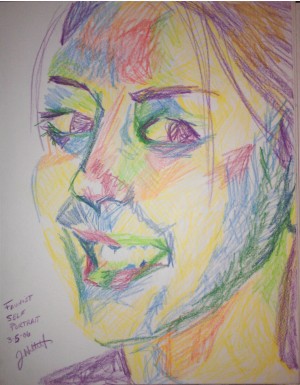
Observations from about 10 years ago, colored pencil on paper.
Dissecting the Details
I’ve learned more about history, religion and culture from looking at and reading about art than I have through most other resources.
Artistic expression hits the soul, the very core of what makes us human and allows us to relate to one another. In the context of history, it shows what was culturally important, how we lived, what life was like before we were intimately connected on a global scale. But most importantly, it shows us that no matter how much time goes by, we never really change.
Sure, things around us change. Dwellings, infrastructure and industries shift, giving rise to new inventions and devices that alter our mannerisms, colloquialisms and interactions. At the heart of everything though, the very nature of human beings remains relatively unchanged.
While at the National Gallery of Art in D.C., I noticed this painting from across the room in another gallery and was immediately drawn to it for its crisp linear perspective and gentle illumination of the interior of the building.
But upon closer inspection, even with all the technical skill displayed, it was the painter’s choices for the narratives within that stood out.
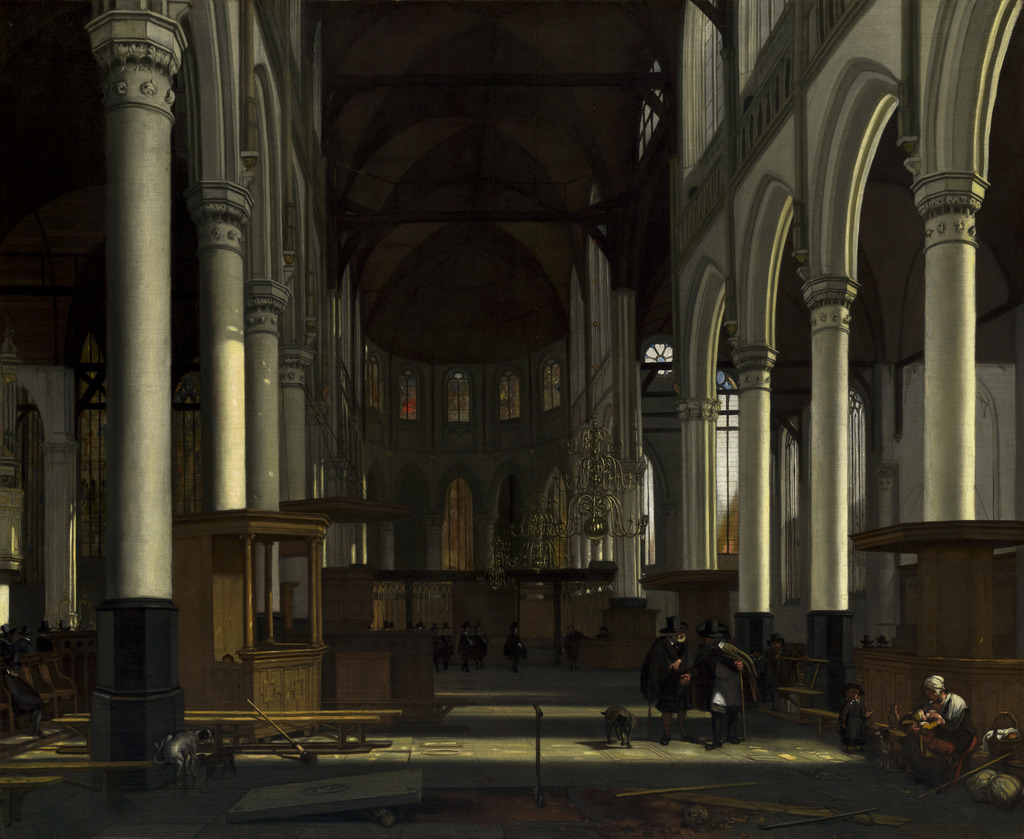
The Interior of the Oude Kerk, Amsterdam, ca.1660 Attributed to Emmanuel de Witte
*Disclaimer: I have done no scholarly research on this painting or its painter other than brief searches and light reading about it. But as a fellow human being, there are a few things I can assert.
It may have been common for dogs to run around in public spaces, but de Witte made a choice here. Instead of only painting a dog’s likeness, he chose to paint a dog in the bottom left corner, urinating on a column in the revered church.
I couldn’t help but smile as I studied the painting. Could there be a reason de Witte made that exact choice? He’d done other paintings of church interiors with animals roaming freely, but none desecrating the space. So, what motivated him to do it in this painting? Was it just an honest representation of a scene de Witte witnessed himeslf? Or could it be a subtle commentary? About the church? About the people nearby, oblivious to the dog’s unabashed marking? Or perhaps (although highly unlikely) de Witte was not a fan of his patron, or he was just having a lousy month, so he cheekily committed his frustrations to the canvas.
Maybe it’s not the greatest example of my point, but I like to think sometimes it’s the little details that give us insight about humanity’s past, and perhaps comfort in knowing that generations before us were not so different. Hopefully, scholars have already figured out the meaning behind the choices de Witte made. And if not, I hope there’s someone trying to understand them.
After all, that’s the really fun part. Asking “Why?” and then piecing the answer together by understanding all of the factors that impacted the final work of art. Trends of the time, wealthy patrons, religious beliefs, an artist’s psychological and physical health, feelings of affection and affinity or hatred and disgust— every detail down to the kind of materials available to create the actual work. Each detail is a sentence intricately written into a greater story.